Mar
16
2023
By Dee Soustek
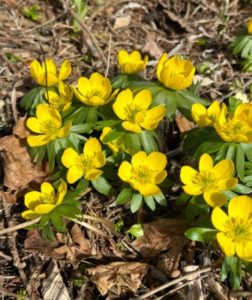 Went to the Kruse Garden to take a short walk, to see what was happening. I was greeted by a small patch of beautiful, vibrant, sunshine yellow flowers of the winter aconite (Eranthus hyemalis). I was surprised to learn that aconite is actually a tuber and not a bulb. These tubers should be planted in the fall the same time you plant your other spring bulbs. Aconite for me, is the harbinger of Spring. It has such a pop of color and it is so cheerful. I hope the Kruse patch of aconite spreads or we add another clump or two.
Then there were the Hellebores that were starting to bloom. One of the earliest flowers to bloom. It’s always fun to see this early bloomer. Tried to take a picture but the downward facing flowers were not cooperating. The new varieties are showing more outward facing blooms, it may be worth a try for this old favorite.
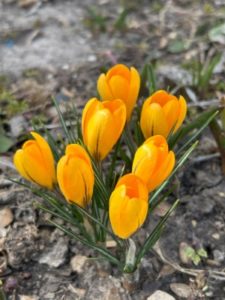 There were many bulbs pushing their way up; tulips, daffodils, hyacinth, and alliums to name a few. But there was a clump of beautiful orange/gold crocus that grabbed my attention, so nice with the sun spotlighting their presence. It sure is a cute little clump, love the color.
Hope you enjoyed the short visit to Kruse and I encourage you to stop by and see what else is ready to bloom.
Feb
16
2023
Anticipation by Kerry Perry
“Every gardener knows that under the cloak of winter lies a miracle … a seed waiting to sprout, a bulb opening to the light, a bud straining to unfurl. And the anticipation nurtures our dream.” – Barbara Winkler
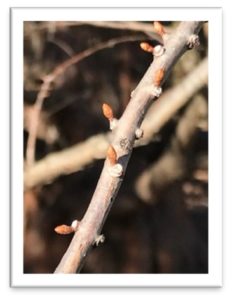
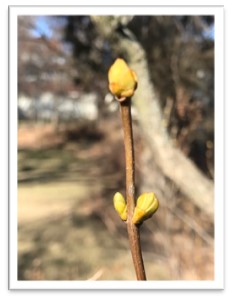
 It’s February and things are awakening in the Kruse garden. Buds are appearing on the Cornelia Cherry Dogwood, Lilac, Dawn Redwood and Viburnum.
Get your gardening gloves and tools ready for spring cleanup. Please join us for fun, learning and comradery.


Nov
10
2022
By Keith Letsche
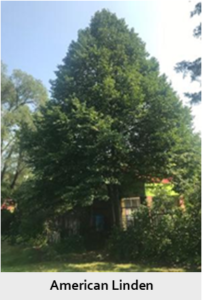 There’s an old adage about missing the forest for the trees. The same might be said about a garden, that we often miss the trees over our enthusiasm for the blooms. Most of the news about the Kruse House garden in this column is about its flowering plants–the patches of daffodils, tulips, and irises in the spring, the summer lilies and rudbeckia, the moon flowers at the end of summer, start of fall.
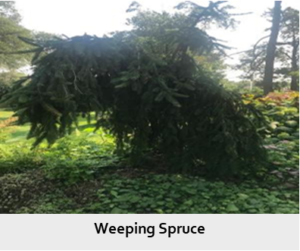 But the trees of Kruse make an important contribution to the garden, too. They provide a background setting for the flower beds and punctuate visual beginnings, middles, and ends within them. They create dappled or shady environments that allow for more varied floral plantings and different moods. And, in some cases, they are just simply beautiful or intriguing in themselves .
 Perhaps the loveliest of the trees on the Kruse property, one that immediately brings to mind Joyce Kilmer’s poem, is the American Linden on the east side with its elegantly tapering canopy. Very different is the Weeping Spruce next to the lily pool, which looks like a piece of modern sculpture. Some trees are also living remnants of the garden’s past. The huge maple in the center, with the benches around its trunk that invite you to come and sit under it, and perhaps even the towering pine on the west side of the shed, were there when Celia Kruse tended the garden.
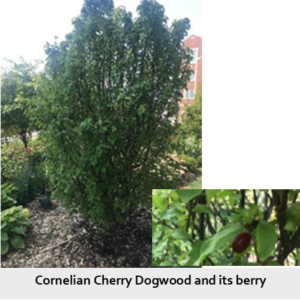 This past year, the garden’s arbor scape got a boost from the Kruse House Gardeners with the planting of several new trees and bushes. Among them was an exquisite Cornelian Cherry Dogwood that was planted at the east of the new side yard flower bed.
So next year when you come out to the Kruse House garden, don’t just stop to smell the flowers. Take a peek at the trees too.
 - Membership